


Best Plots in Kompally: Gated Community vs. Open Layout – Which Is Better?
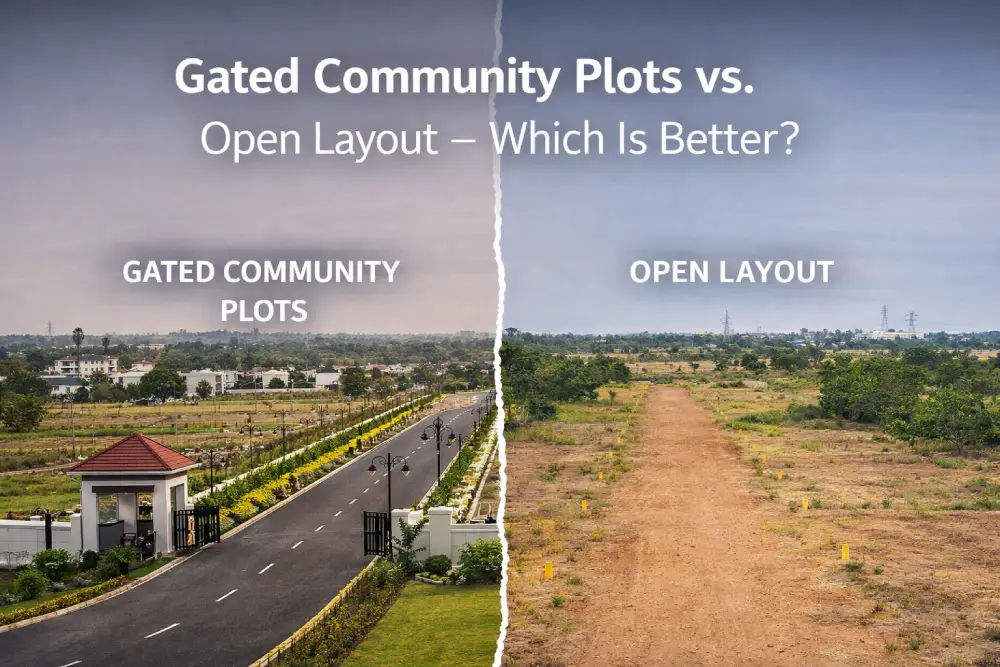
If you’ve been searching for the best plots in Kompally, you’ve likely noticed that listings fall into two broad categories: gated community plots and open layout plots. Both come with their own price points, advantages, and trade-offs. Choosing between them isn’t as simple as picking the cheaper option — it depends on what you actually plan to do with the land.
This guide breaks down both types honestly, so you can figure out which one makes sense for your situation.
What Is a Gated Community Plot?
A gated community plot sits inside a planned, enclosed development. The entire project – roads, drainage, utilities, parks, security infrastructure is developed by the builder before you even move in. Access is controlled, usually with a manned gate or security system.
These projects come with a homeowners’ association or maintenance structure that keeps the common areas functional over time. When you buy a gated plot, you’re not just buying land you’re buying into a managed environment.
Typical Features:
- Compound wall around the entire project
- 24/7 security
- Internal roads (40 ft. and 33 ft. wide roads are standard in quality projects)
- Underground drainage and sewerage
- Common amenities: parks, clubhouse, swimming pool, sports courts
- Street lighting
- Water supply to each plot
What Is an Open Layout Plot?
An open-layout plot is a simpler product. It’s a piece of land within a layout that may have DTCP or RERA approval, defined roads, and basic infrastructure — but no perimeter wall, no gated access, and no shared amenities. You own the land, and what you do with it is up to you.
Open layouts are not inferior by nature. Many buyers prefer them for the flexibility and typically lower price per sq. yard.
Typical features:
- Approved layout with surveyed plot numbers
- Roads (may or may not be developed)
- No shared amenities
- No maintenance charges
- Lower cost of entry
Gated Community vs. Open Layout: A Direct Comparison
1. Price
Open layouts almost always cost less per sq. yard. You’re paying for land and legal approval, not for a swimming pool or 24/7 security. If budget is the main factor, an open layout gives you more land for the same money.
Gated community plots carry a premium — sometimes 15–30% higher — because the developer has already invested in infrastructure. But that premium doesn’t disappear when you sell. Gated plots tend to hold value better and often appreciate faster in developing corridors.
2. Appreciation Potential
Both can appreciate significantly, but the factors differ.
For open layouts, appreciation depends almost entirely on the location and macro factors: road development, industrial growth nearby, and how fast the area urbanises. If you buy in the right corridor early enough, the returns can be excellent.
For gated plots, appreciation is driven by those same macro factors plus the quality of the development itself. A well-maintained gated community with good amenities retains demand even when surrounding areas see slower growth. Buyers are willing to pay more for a plot that already has infrastructure in place.
3. End Use: Build or Invest?
This is the question most buyers don’t think about clearly enough.
If you plan to build immediately, a gated community makes more practical sense. Roads are in, water is connected, drainage works, security is present. You can start construction without coordinating basic infrastructure.
If you’re buying to hold as a long-term investment with no immediate building plan, an open layout in a strong growth corridor can deliver comparable returns at a lower entry cost.
If you’re buying a farmhouse or weekend retreat — a category that’s grown significantly around Hyderabad’s northern belt — gated plots with resort-like amenities are increasingly preferred. The whole point is having somewhere that’s usable on weekends without the hassle of maintenance.
4. Legal Safety
Both types can be legally sound — the key is the approval. In Telangana, DTCP approval (from the Directorate of Town and Country Planning) is what you want to see on the layout map. RERA registration adds another layer of accountability.
The risk in open layouts is less about the legal structure and more about due diligence on land title, encumbrances, and whether the layout actually has the promised road widths. In practice, there have been many cases where open-layout buyers discovered road widths were narrower than advertised or that drainage was never developed.
Gated community projects typically go through more rigorous documentation before launch because the builder is investing heavily in development, not just selling land.
5. Maintenance and Long-Term Costs
Gated community plots come with annual maintenance charges. These can range from ₹5,000 to ₹20,000+ per year depending on the scale of amenities. It’s an ongoing cost even if you don’t build.
Open layouts have no maintenance charges. You own the land and pay property taxes, and that’s it.
For long-term investors who won’t visit the land for years, maintenance charges can feel like dead weight. For buyers who want a usable plot with functional infrastructure, those charges are worthwhile.
What Buyers in Kompally and North Hyderabad Are Actually Doing
The corridor stretching north from Kompally through the Medak district has seen sustained buyer interest over the past several years. The proposed Regional Ring Road (RRR) has been the main driver — once it’s operational, connectivity to Hyderabad’s peripheral hubs changes significantly.
Buyers in this corridor are split roughly into three groups:
The investor: Buying 147–200 sq. yard plots in gated projects to hold for 5–7 years. They want legal clarity, a reputable developer, and something they can liquidate when the time comes.
The family buyer: Looking for a larger plot (300–600 sq. yards) to either build a weekend home or retire to. They want amenities, security, and a community that exists on paper and on the ground.
The NRI buyer: Many NRIs from Gulf countries and other regions are putting money into Hyderabad land rather than keeping liquid assets in depreciating currencies. For them, the priority is a trusted developer with a track record, clear documentation, and resale liquidity.
When searching for the best plots in Kompally or nearby areas, all three buyer profiles tend to land on the same question: is this developer going to deliver what they’ve promised?
Red Flags to Watch For
Whether you’re buying a gated plot or an open layout, keep an eye out for the following:
- No DTCP or RERA number: Walk away. This is non-negotiable.
- Road widths that are vague on paper: Get the technical layout document, not just the brochure.
- No compound wall or infrastructure on site: If the gated community is selling plots but there’s no actual construction happening on common infrastructure, that’s a concern.
- Unrealistic appreciation claims: Any agent promising “3x returns in 3 years” is selling you a story. Land appreciates—but timelines depend on external factors no one can fully predict.
- Developer track record: How many projects have they completed? Did they deliver on time? Talk to existing customers if you can.
So, Which Is Better?
Honestly, neither is categorically better. The right choice depends on:
- Budget: Open layout if you’re working with a tighter number.
- Timeline: Gated community if you want to build soon or use the property within a few years.
- Purpose: Weekend/farmhouse use — gated, with amenities. Pure investment hold — either works if the location is right.
- Risk tolerance: Gated projects with established developers carry less execution risk.
The one thing buyers consistently regret isn’t the choice between gated and open—it’s buying in the wrong location or from a developer who didn’t follow through.
Conclusion: Aamvana Avenue by APD Developers
If you’ve been seriously looking at the best plots in Kompally and the North Hyderabad growth corridor, Aamvana Avenue by APD Developers deserves a closer look.
Located in Masaipet on NH-44, Aamvana Avenue sits just 2 km from the proposed Regional Ring Road (RRR) and 4 km from the Outer Ring Road (ORR). That’s not a peripheral location; it’s directly in the path of the infrastructure growth that’s been reshaping this corridor.
APD Developers has been around since 1995. They’ve completed 43 ventures, developed over 700 acres, and — this is the part worth noting — sold out every project within six months of launch. That kind of track record isn’t marketing copy; it reflects genuine buyer confidence.
Aamvana Avenue is DTCP-approved and TG RERA registered. Phase 1 has 279 plots ranging from 147 to 600 sq. yards. What sets it apart from most gated projects in the region is the resort-like infrastructure: fine dining restaurant, family swimming pool, yoga and meditation zones, amphitheatre, badminton court, cricket box net, kids’ play zones, and luxury suites—all within the campus.
It’s built around the Pancha Jeevana concept, which organises the development into five experiential zones covering Nature, Wellness, Bonding, Culture, and Belonging.
For buyers looking for the best plots in Kompally with genuine amenity depth, strong connectivity, and a developer who’s actually built and delivered before, this is the kind of project worth calling about.